
Nordic Semiconductor
nRF54LM20A · nRF54L15 · nRF54H20 · nRF5340 · nRF52840
Services / Wireless Engineering
2.4GHz and BLE wireless product development with Nordic · TI · Silicon Labs · Espressif · NXP · Telink.
From chip and module selection to circuit design, tuning, certification and production.
01 / Vendor Selection
We set the development direction by weighing protocol, power consumption, size and target cost together.
Product requirements
Compare requirements
Chip and module candidates
nRF54LM20A · nRF54L15 · nRF54H20 · nRF5340 · nRF52840
Review radio support, processing performance, memory and RF specifications to find the model that fits your product requirements.
| Model | nRF54LM20A | nRF54L15 | nRF54H20 | nRF5340 | nRF52840 |
|---|---|---|---|---|---|
| Good fit for | BLE and multiprotocol devices that need more memory or high-speed USB | Battery-powered low-power BLE and multiprotocol devices | BLE, Thread and Matter devices that need high processing performance | BLE devices that need LE Audio or dual-core processing | Designs and maintenance that use USB and the existing nRF52 ecosystem |
| Radio support | Bluetooth LE (incl. Channel Sounding), Thread · Zigbee (IEEE 802.15.4), Matter, proprietary 2.4GHz | Bluetooth LE (incl. Channel Sounding), Thread · Zigbee (IEEE 802.15.4), Matter, proprietary 2.4GHz | Bluetooth LE, Thread, Matter, proprietary 2.4GHz | Bluetooth LE (incl. Direction Finding) · Mesh, Thread, Zigbee, Matter, ANT, NFC, proprietary 2.4GHz | Bluetooth LE · Mesh, Thread, Zigbee, IEEE 802.15.4, ANT, NFC |
| MCU / max clock | Arm Cortex-M33 128MHz + RISC-V coprocessor 128MHz | Arm Cortex-M33 128MHz + RISC-V coprocessor 128MHz | Multiple Arm Cortex-M33 (up to 320MHz) + RISC-V coprocessors | Application Cortex-M33 128 / 64MHz + network Cortex-M33 64MHz | Arm Cortex-M4F 64MHz |
| Non-volatile memory / RAM | 2MB NVM · 512KB RAM (on-chip) | 1.5MB NVM · 256KB RAM (on-chip) | 2MB NVM · 1MB RAM (on-chip) | 1MB + 256KB flash · 512KB + 64KB RAM (per core, on-chip) | 1MB flash · 256KB RAM (on-chip) |
| Max TX power · conditions | +8 dBm (CSP) · +7 dBm (QFN) | +8 dBm (CSP) · +7 dBm (QFN) | +10 dBm | +3 dBm (setting range +3 to −20 dBm) | +8 dBm |
| Package · size | CSP98 3.67 × 3.85mm · CSP61 3.02 × 2.43mm · QFN52 6 × 6mm | CSP47 2.45 × 2.25mm · QFN52 · QFN48 6 × 6mm · QFN40 5 × 5mm | Check official documents | aQFN94 7 × 7mm · WLCSP95 4.4 × 4.0mm | aQFN73 7 × 7mm · QFN48 6 × 6mm · WLCSP 3.5 × 3.6mm |
| Status | CSP98: Mass production · CSP61, QFN52: Early sampling (per Nordic) | CSP47, QFN52, QFN48: Mass production · QFN40: Early sampling (per Nordic) | No availability status on the product page | No availability status on the product page | No availability status on the product page |
| Official source | Product page | Product page | Product page | Product page · Product brief v2.2 | Product page |
CC2340R5 · CC2745R10-Q1 · CC2674R10 · CC2652P7
Review radio support, processing performance, memory and RF specifications to find the model that fits your product requirements.
| Model | CC2340R5 | CC2745R10-Q1 | CC2674R10 | CC2652P7 |
|---|---|---|---|---|
| Good fit for | Small low-power BLE devices — remotes, tags, sensors | Automotive BLE and Channel Sounding ranging (AEC-Q100 Grade 2) | Devices combining Matter, Thread or Zigbee with BLE | Multiprotocol devices that need high output from an integrated PA |
| Radio support | Bluetooth LE (qualified against Core 5.4), Zigbee, Thread, proprietary 2.4GHz | Bluetooth LE (Core 6.0 qualified, Channel Sounding) | Thread, Zigbee, Matter, Bluetooth 5.3 LE, 6LoWPAN, proprietary | Thread, Zigbee, Matter, Bluetooth 5.2 LE, 6LoWPAN, proprietary |
| MCU / max clock | Arm Cortex-M0+ 48MHz | Arm Cortex-M33 96MHz + Algorithm Processing Unit 96MHz | Arm Cortex-M33 48MHz | Arm Cortex-M4F 48MHz |
| Non-volatile memory / RAM | 512KB flash · 36KB (R52) / 64KB (R53) SRAM | Up to 1MB flash · up to 162KB SRAM | 1024KB flash · 256KB SRAM (+ 8KB cache) | 704KB flash · 144KB SRAM (+ 8KB cache) |
| Max TX power · conditions | +8 dBm | +10 dBm (R variant) · +20 dBm on the P variant | +5 dBm (datasheet maximum output) | +20 dBm (integrated PA) |
| Package · size | QFN24 4 × 4mm · QFN40 5 × 5mm · WCSP 2.2 × 2.6mm (R53) | QFN40 6 × 6mm (wettable flank) | VQFN48 7 × 7mm · VQFN64 8 × 8mm | VQFN48 7 × 7mm |
| Status | ACTIVE (per TI) | ACTIVE (per TI) | ACTIVE (per TI) | ACTIVE (per TI) |
| Official source | Product page · Datasheet SWRS272F | Product page · Datasheet SWRS304D | Product page · Datasheet SWRS268B | Product page |
EFR32BG22 · EFR32BG27 · EFR32MG21 · EFR32MG24 · EFR32MG26
Review radio support, processing performance, memory and RF specifications to find the model that fits your product requirements.
| Model | EFR32BG22 | EFR32BG27 | EFR32MG21 | EFR32MG24 | EFR32MG26 |
|---|---|---|---|---|---|
| Good fit for | Ultra-low-power, battery-powered BLE devices | Very small, coin-cell BLE devices | Line-powered Zigbee and Thread devices — lighting, gateways | Matter, Thread and Zigbee smart-home devices; AI/ML accelerator on selected parts | Matter devices and gateways that need more memory |
| Radio support | Bluetooth LE (Bluetooth 5.4), AoA/AoD direction finding, Bluetooth Mesh Low Power Node (512KB parts), proprietary | Bluetooth LE (Bluetooth 5.4) · Mesh, proprietary | Zigbee, Thread, Bluetooth LE (Bluetooth 5.1 compatible) · Mesh | Matter, OpenThread, Zigbee, Bluetooth LE · Mesh, proprietary 2.4GHz, Channel Sounding | Matter, OpenThread, Zigbee, Bluetooth LE (BLE 5.3), proprietary 2.4GHz |
| MCU / max clock | Arm Cortex-M33 76.8MHz | Arm Cortex-M33 76.8MHz | Arm Cortex-M33 80MHz | Arm Cortex-M33 78MHz | Arm Cortex-M33 78MHz |
| Non-volatile memory / RAM | Up to 512KB flash · up to 32KB RAM | Up to 768KB flash · up to 64KB RAM | 512–1024KB flash · 64–96KB RAM (by part number) | 1024 / 1536KB flash · 128–256KB RAM (by part number) | Up to 3200KB flash · up to 512KB RAM |
| Max TX power · conditions | +6 dBm | +8 dBm | +20 dBm or +10 dBm (by part number) | +19.5 dBm or +10 dBm (by part number) · +10 dBm for Channel Sounding | +19.5 dBm |
| Package · size | QFN40 5 × 5mm · QFN32 4 × 4mm · TQFN32 4 × 4 × 0.3mm | WLCSP39 2.3 × 2.6mm · QFN32 4 × 4mm · QFN40 5 × 5mm | QFN32 4 × 4mm | QFN40 5 × 5mm · QFN48 6 × 6mm | QFN48 6 × 6mm · QFN68 8 × 8mm · BGA136 7 × 7mm |
| Status | No separate availability status on the product page | No separate availability status on the product page | No separate availability status on the product page | No separate availability status on the product page | No separate availability status on the product page |
| Official source | Product page | Product page | Product page | Datasheet Rev 1.2 | Product page |
ESP32-C6 · ESP32-H2 · ESP32-C5 · ESP32-C3 · ESP32-S3
Review radio support, processing performance, memory and RF specifications to find the model that fits your product requirements.
| Model | ESP32-C6 | ESP32-H2 | ESP32-C5 | ESP32-C3 | ESP32-S3 |
|---|---|---|---|---|---|
| Good fit for | Smart-home devices combining Wi-Fi 6, BLE and Thread/Zigbee | Devices that need BLE and Thread/Zigbee without Wi-Fi | Devices that need dual-band 2.4 / 5GHz Wi-Fi 6 | Devices that need basic Wi-Fi 4 + BLE | Wi-Fi + BLE devices that need dual-core performance |
| Radio support | Wi-Fi 6 (802.11ax, 2.4GHz only), Bluetooth LE (5.3 certified), IEEE 802.15.4 (Zigbee · Thread) | Bluetooth LE (5.3 certified), IEEE 802.15.4 (Zigbee · Thread) | Wi-Fi 6 (802.11ax, dual-band 2.4 / 5GHz), Bluetooth LE (Core 6.0 certified), IEEE 802.15.4 (Zigbee · Thread) | Wi-Fi 4 (802.11b/g/n, 2.4GHz), Bluetooth LE (Bluetooth 5) · Mesh | Wi-Fi 4 (802.11b/g/n, 2.4GHz), Bluetooth LE (Bluetooth 5) · Mesh |
| MCU / max clock | RISC-V HP 160MHz + LP 20MHz | RISC-V 96MHz | RISC-V HP 240MHz + LP 48MHz | RISC-V 160MHz | Xtensa LX7 dual-core 240MHz |
| Non-volatile memory / RAM | 512KB HP SRAM + 16KB LP SRAM · flash: 4 / 8MB in package (QFN32) or external | 320KB SRAM · 2 / 4MB flash in package | 384KB HP SRAM + 16KB LP SRAM · flash / PSRAM: in-package variants or external | 400KB SRAM (incl. 16KB cache) · flash: 4 / 8MB in-package variants or external | 512KB SRAM · flash / PSRAM: in-package variants or external |
| Max TX power · conditions | Wi-Fi 21 dBm (typ.) · BLE / 802.15.4 up to +20 dBm | BLE / 802.15.4 up to +20 dBm | Wi-Fi 2.4GHz 20 dBm (typ.) · BLE / 802.15.4 up to +20 dBm | Wi-Fi 21 dBm (typ.) · BLE up to +20 dBm | Wi-Fi 21 dBm (typ.) · BLE up to +20 dBm |
| Package · size | QFN40 5 × 5mm · QFN32 5 × 5mm | QFN32 4 × 4mm | QFN48 6 × 6mm · LGA48 6 × 6mm | QFN32 5 × 5mm | QFN56 7 × 7mm |
| Status | Datasheet v1.5 official release (Espressif: for products in mass production) | Datasheet v1.3 official release (Espressif: for products in mass production) | Datasheet v1.5 official release (Espressif: for products in mass production) | Datasheet v2.4 official release · ESP32-C3FN4: EOL · ESP32-C3FH4AZ: NRND | Datasheet v2.2 official release · ESP32-S3R8V, ESP32-S3R2: EOL |
| Official source | Datasheet v1.5 | Datasheet v1.3 | Datasheet v1.5 | Datasheet v2.4 | Datasheet v2.2 |
KW45 · KW47 · MCX W71 · MCX W72 · RW612
Review radio support, processing performance, memory and RF specifications to find the model that fits your product requirements.
| Model | KW45 | KW47 | MCX W71 | MCX W72 | RW612 |
|---|---|---|---|---|---|
| Good fit for | Automotive BLE (AEC-Q100 Grade 2) | Automotive and industrial BLE Channel Sounding ranging | Devices combining Matter, Thread or Zigbee with BLE | Devices combining BLE 6 Channel Sounding with 802.15.4 | Gateways and appliances using Wi-Fi 6, BLE and Thread on one chip |
| Radio support | Bluetooth LE 6.0 (upgradeable radio) | Bluetooth LE 6.x, Channel Sounding | Bluetooth LE 5.3, IEEE 802.15.4 (Thread · Zigbee), Matter | Bluetooth LE 6 certified, Channel Sounding, IEEE 802.15.4 (Thread · Zigbee) | Wi-Fi 6 (802.11ax, 2.4 / 5GHz), Bluetooth LE (5.4 certified), IEEE 802.15.4 (Thread), Matter over Wi-Fi / Thread |
| MCU / max clock | Arm Cortex-M33 96MHz + dedicated radio Cortex-M3 | Arm Cortex-M33 96MHz + dedicated radio Cortex-M33 64MHz | Arm Cortex-M33 96MHz + dedicated radio Cortex-M3 | Arm Cortex-M33 96MHz + dedicated radio Cortex-M33 | Arm Cortex-M33 260MHz |
| Non-volatile memory / RAM | 1MB flash · 128KB SRAM (radio: separate 256KB flash · 88KB SRAM) | Up to 2MB flash · 264KB SRAM (radio: separate 512KB flash · 171KB SRAM) | 1MB flash · 128KB SRAM (radio: separate 256KB flash · 88KB SRAM) | 2MB flash · 264KB SRAM | 1.2MB SRAM (on-chip) · external flash (FlexSPI, up to 128MB) |
| Max TX power · conditions | +10 dBm | +10 dBm | +10 dBm | +10 dBm | Wi-Fi up to +21 dBm (product page) / +23 dBm (datasheet Rev 9.0) · BLE / 802.15.4 up to +15 dBm |
| Package · size | HVQFN40 6 × 6mm · HVQFN48 7 × 7mm (wettable flank) | HVQFN48 7 × 7mm (wettable flank) | QFN48 7 × 7mm · QFN40 6 × 6mm | QFN48 7 × 7mm | RW61x family: HVQFN116 9 × 9mm · TFBGA145 8 × 8mm (by part number) |
| Status | Active (per NXP) | Active (per NXP) | Active (per NXP) | Active (per NXP) | Active (per NXP, A2 part numbers) |
| Official source | Product page | Product page | Product page | Product page | Product page · Datasheet Rev 9.0 · Fact sheet |
TL7218 · TL3218 · TLSR9218A · TLSR8278 · TLSR8258
Review radio support, processing performance, memory and RF specifications to find the model that fits your product requirements.
| Model | TL7218 | TL3218 | TLSR9218A | TLSR8278 | TLSR8258 |
|---|---|---|---|---|---|
| Good fit for | Latest generation supporting BLE, Zigbee, Thread and Matter | Low-power BLE and 802.15.4 devices | Multiprotocol IoT devices such as Matter or HomeKit | BLE and Mesh devices including HomeKit or Find My | Existing-generation designs using BLE, Mesh and Zigbee |
| Radio support | Bluetooth LE (Bluetooth 6.0), Zigbee, Thread, Matter, proprietary 2.4GHz | Bluetooth LE (Bluetooth 6.1), IEEE 802.15.4, proprietary 2.4GHz | Bluetooth LE (5.4) · Mesh, Zigbee, Thread, Matter, Apple HomeKit · Find My, proprietary 2.4GHz | Bluetooth LE (5.4) · Mesh, Zigbee, RF4CE, Apple HomeKit · Find My, proprietary 2.4GHz | Bluetooth LE (5.4) · Mesh, Zigbee, RF4CE, proprietary 2.4GHz |
| MCU / max clock | RISC-V 32-bit · clock: check official documents | RISC-V 32-bit · clock: check official documents | RISC-V 32-bit · clock: check official documents | T-MCU 32-bit · clock: check official documents | T-MCU 32-bit · clock: check official documents |
| Non-volatile memory / RAM | 2MB flash · 512KB SRAM | 1MB flash · 128KB SRAM | 1MB flash · 256KB SRAM | 1MB flash · 64KB SRAM | 512KB / 1MB flash · 64KB SRAM (by part number) |
| Max TX power · conditions | Check official documents | Check official documents | Check official documents | Check official documents | Check official documents |
| Package · size | QFN68 8 × 8mm · QFN38 4 × 4mm · BGA94 4 × 6mm · BGA56 3.4 × 3mm | QFN52 6 × 6mm · LGA42 2.7 × 2.5mm · QFN32 4 × 4mm · QFN28 3.5 × 3.5mm | QFN48 6 × 6mm | QFN48 7 × 7mm (TLSR8278F1KET48) | QFN32 5 × 5mm · TQFN48 · QFN48 7 × 7mm |
| Status | No availability status on the product page | No availability status on the product page | No availability status on the product page | No availability status on the product page | No availability status on the product page |
| Official source | Product page | Product page | Product page | Product page | Product page |
02 / Engineering Scope
Wireless performance is not set by the circuit and antenna alone. Firmware settings (TX power, PHY, duty cycle) and mechanical conditions (enclosure material, part placement, ground) affect it too.
03 / Applications
Examples of applicable fields, not individual customer cases.
04 / RF Tuning Report
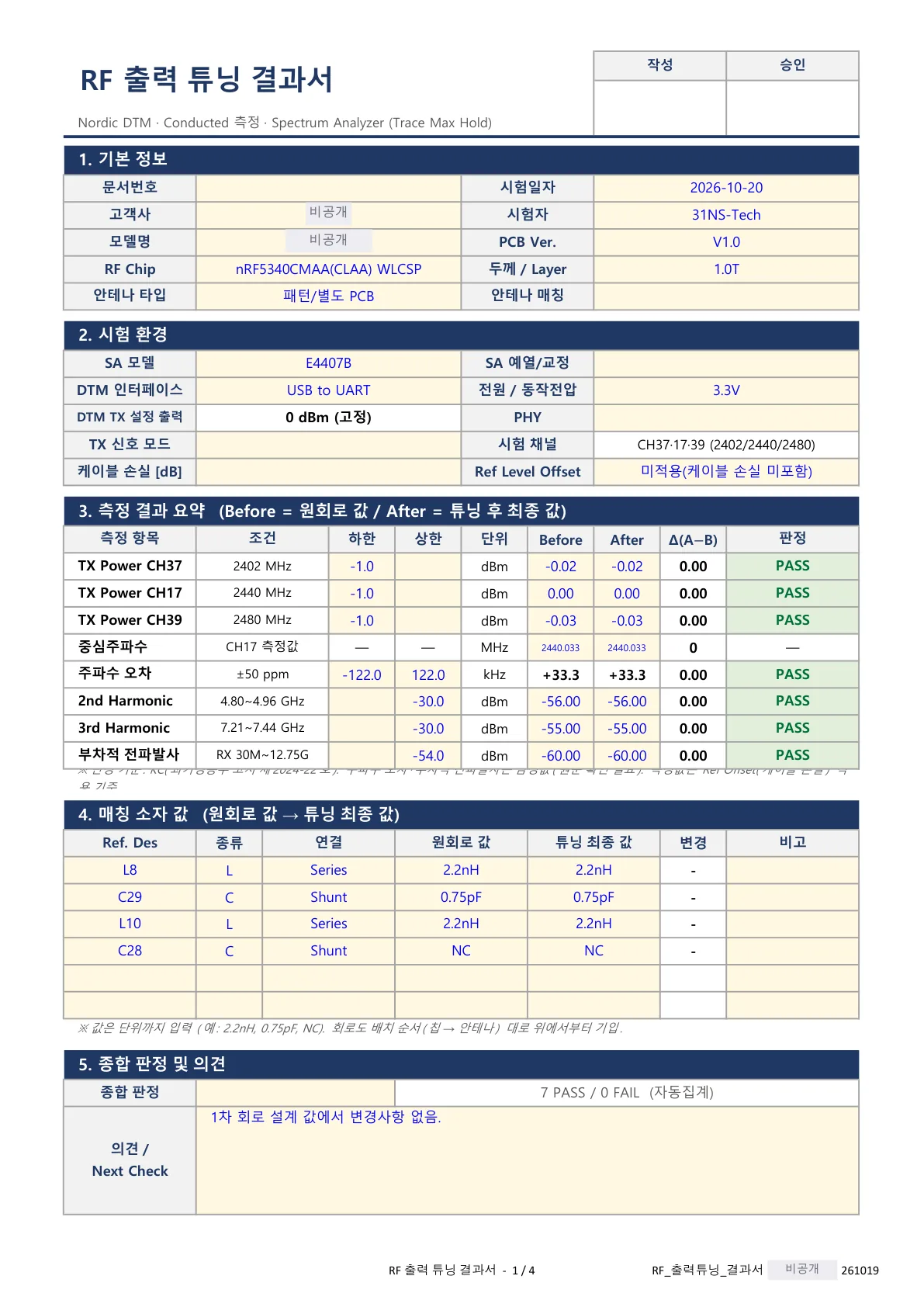
An RF output tuning report from a BLE product. Transmit power per channel, frequency error, harmonics and spurious emissions are measured and judged against the KC standard, and the antenna matching values are fixed.
| Item | Condition | Limit | Measured | Result |
|---|---|---|---|---|
| TX Power CH37 | 2402 MHz | ≥ −1.0 dBm | −0.02 dBm | PASS |
| TX Power CH17 | 2440 MHz | ≥ −1.0 dBm | 0.00 dBm | PASS |
| TX Power CH39 | 2480 MHz | ≥ −1.0 dBm | −0.03 dBm | PASS |
| Frequency error | ±50 ppm (CH17) | ±122 kHz | +33.3 kHz | PASS |
| 2nd Harmonic | 4.80–4.96 GHz | ≤ −30 dBm | −56.00 dBm | PASS |
| 3rd Harmonic | 7.21–7.44 GHz | ≤ −30 dBm | −55.00 dBm | PASS |
| Spurious emission (RX) | 30 MHz–12.75 GHz | ≤ −54 dBm | −60.00 dBm | PASS |
Measured values are conducted measurements without cable-loss correction. The matching parts (series 2.2nH · shunt 0.75pF · series 2.2nH) were kept at the first design values.
From Knowledge to Product
Start by telling us your current challenge and the features you need.